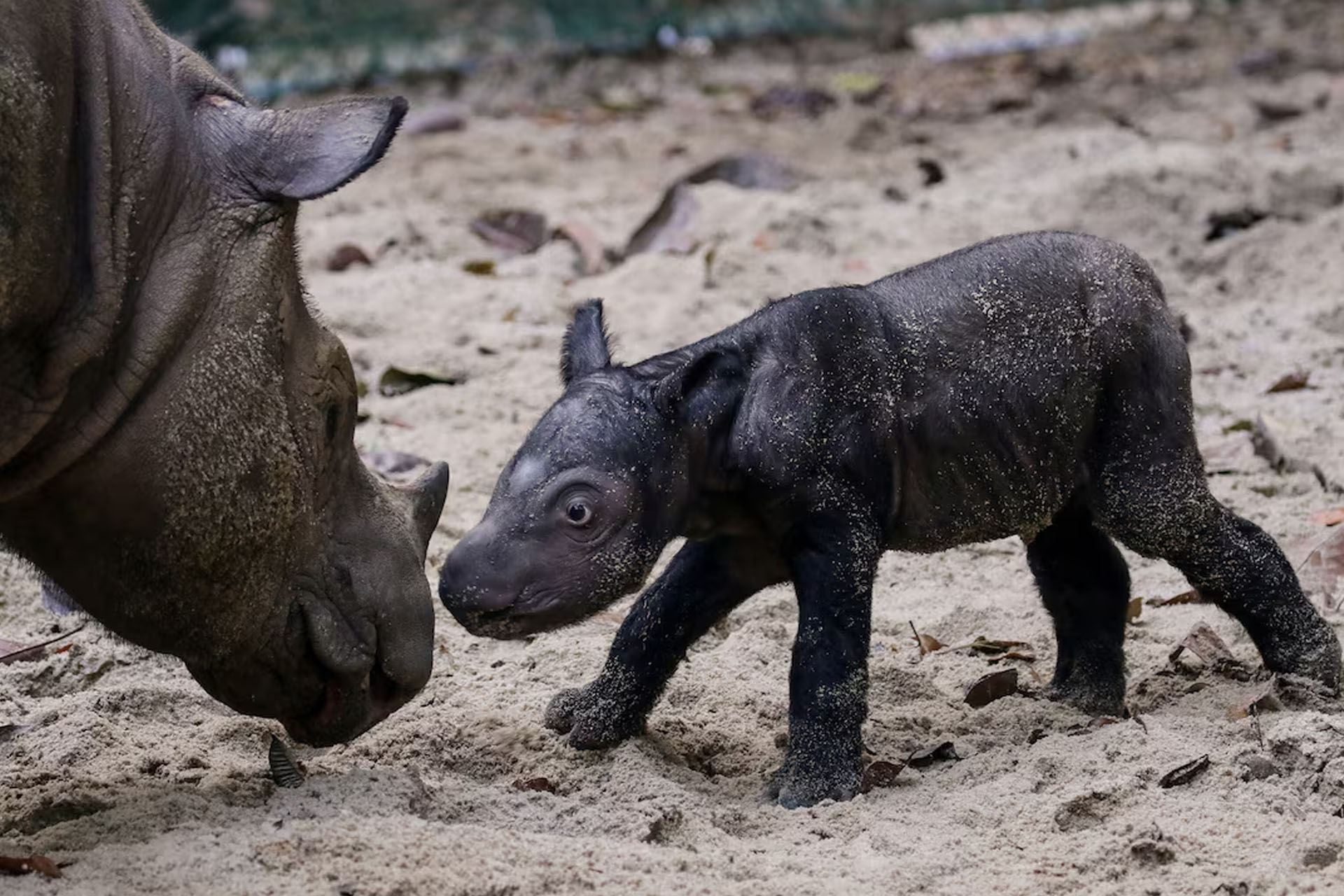

Deep inside the rainforests of Sumatra, at a sanctuary that has become the last stronghold for one of the planet's rarest creatures, a new life has arrived. A male Sumatran rhino calf was born at the Sumatran Rhino Sanctuary in Way Kambas National Park, in Indonesia's Lampung province a birth that conservationists are calling a pivotal moment in the fight to pull this species back from the edge of extinction.
The calf, weighing roughly 25 kilograms at birth, was discovered by a conservation guard who found the newborn standing beside its mother, Delilah, on a quiet Saturday morning ten days ahead of the expected delivery date. Within hours, the calf was on its feet and breastfeeding, a sign that both mother and baby are in strong health.
Table of Contents
A Father With a Story
Behind every birth in a critically endangered species, there is a larger narrative and in this case, the father's journey is remarkable. The calf was sired by Harapan, a male born at the Cincinnati Zoo in 2006. Harapan holds a singular distinction: he was the last Sumatran rhino in the world to be repatriated back to Indonesia. His return to native soil means that, for the first time, the entire remaining global population of Sumatran rhinos now resides within Indonesia's borders.
This birth emphasises the commitment of the Indonesian government to rhino conservation efforts especially for the Sumatran rhino.
Why This Birth Matters So Much
To understand the weight of this moment, you need to understand just how close the Sumatran rhino has come to disappearing forever. Once widespread across Southeast Asia, the species the smallest of the world's five remaining rhino types has been decimated over the past century. The IUCN Red List classifies the Sumatran rhino as critically endangered, with only around 30 mature individuals believed to remain in the wild. The total population, including those in captivity, hovers below 50.

This calf is not the first success story at Way Kambas, but it is a deeply significant one. It marks the second Sumatran rhino born in Indonesia in the same year a rare double milestone. The sanctuary has now recorded five live births from its semi-natural breeding program, a testament to years of patient, science-backed conservation work.
The Threats That Linger
The birth is cause for celebration, but it does not erase the deep structural threats facing Sumatran rhinos. Conservationists are careful to frame this news not as a victory, but as a single, hard-won step in an ongoing battle.
Poaching
Rhino horns remain highly prized in traditional medicine and as ornaments across parts of Asia, fuelling a persistent illegal trade.
Habitat Destruction
Tropical deforestation across Sumatra continues to shrink and fragment the rhino's natural range at an alarming rate.
Climate Change
Shifting weather patterns and rising temperatures are altering forest ecosystems that Sumatran rhinos depend on to survive.
Genetic Vulnerability
With so few individuals remaining, inbreeding risks grow with each generation threatening the species' long-term viability.
A Wider Crisis Among the World's Rhinos
The Sumatran rhino's plight is not an isolated story. It sits within a broader, global crisis affecting every one of the world's five remaining rhino species. Malaysia declared the Sumatran rhino extinct within its borders in 2015, and the death of the last female there named Iman cemented that grim reality. Meanwhile, the western black rhino was declared fully extinct in 2013, and the last male northern white rhino died in 2018, leaving only two females alive today kept in a sanctuary in Kenya.

Indonesia, aware of the weight it carries, has made Sumatran rhino conservation a national priority. The captive breeding program at Way Kambas developed in collaboration with international bodies like the International Rhino Foundation is designed not just to keep the species alive, but to eventually increase rhino numbers enough to reintroduce them into protected wild habitats.
A Timeline of Hope
Andatu is born at the Way Kambas sanctuary the first Sumatran rhino born in captivity in Indonesia in 124 years.
The Sumatran rhino is declared extinct in Malaysia, shifting the entire conservation burden to Indonesia.
Delilah is born at the sanctuary she will go on to become the mother of the latest calf.
A female Sumatran rhino calf is born at Way Kambas, bringing the sanctuary population to eight and reigniting global hope.
Two Sumatran rhino calves are born in the same year including Delilah's son marking the most successful year for the species in over a decade.
Sumatran rhinos are long-lived animals, with a life expectancy of 35 to 40 years, according to the WWF. That means each individual and each birth carries an outsized importance for the species' genetic diversity and future. The newborn calf at Way Kambas is, in every sense, more than a baby rhino. It is a data point in a decades-long race against extinction.

For now, the calf remains unnamed, resting beside Delilah in the quiet green of the sanctuary. But across the conservation world, the news has already rippled a rare, unambiguous piece of good news in an era when stories about endangered species too often end differently.